
I’ve been working with homeowners for over two decades, and I can tell you that the conversation about consolidating credit card debt into a mortgage happens more often than you’d think.
The appeal makes sense on the surface. You’re carrying high-interest credit card balances that never seem to shrink, and your home equity is sitting there, offering access to significantly lower interest rates. The math looks good. The monthly payment drops. The stress eases.
But here’s what I need you to understand before you move forward with this decision.
The Structure Changes Everything
When you roll credit card debt into your mortgage, you’re doing more than just lowering your interest rate. You’re fundamentally changing the nature of your debt.
Credit card debt is unsecured. If things go sideways and you can’t pay, it damages your credit and creates financial stress, but you don’t lose your home. The moment you consolidate that debt into your mortgage, you’ve converted unsecured debt into secured debt. Your home is now on the line for purchases you made months or years ago.
That shift in risk profile matters more than most people realize when they’re focused on the immediate relief of a lower monthly payment.
The Real Question Isn’t About Rate
Most homeowners come to me asking about rates and terms. Those are important, but they’re not the first question I ask.
The first question is this: what created the credit card debt in the first place, and has that situation changed?
If you accumulated debt because of a one-time emergency, a job loss you’ve recovered from, or a specific circumstance that’s now resolved, consolidation can make sense. You’re using your home equity to clean up a mess that won’t repeat itself.
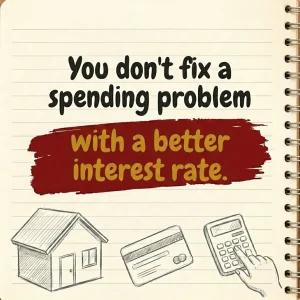
But if the debt accumulated because your monthly expenses consistently exceed your income, consolidating into your mortgage doesn’t solve anything. It just resets the clock. You’ll have a lower mortgage payment for a while, but without addressing the underlying cash flow problem, you’ll end up right back where you started—except now you’ll have credit card debt again AND a larger mortgage.
I’ve seen this pattern play out too many times. Someone consolidates $30,000 in credit card debt into their mortgage, feels relieved for six months, and then slowly rebuilds that credit card balance because the spending habits never changed. Two years later, they’re in a worse position than when they started.
The Discipline Factor
Here’s the uncomfortable truth about debt consolidation: it only works if you have the discipline to change your financial behavior afterward.
Credit cards are revolving debt. There’s no end date. You can carry a balance indefinitely, making minimum payments that barely touch the principal. It’s a structure designed to keep you in debt.
A mortgage is different. It has a defined term and a structured repayment schedule. Every payment you make reduces the principal. There’s a clear path to being debt-free, assuming you don’t refinance or extend the term repeatedly.
When you consolidate credit card debt into your mortgage, you’re trading the indefinite nature of revolving debt for the structured repayment of a mortgage. That’s a good trade—but only if you commit to not rebuilding the credit card debt.
This requires real discipline. It means creating a budget and sticking to it. It means understanding where your money goes every month and making conscious decisions about spending. It means treating your credit cards differently than you did before.
If you’re not ready to make those changes, consolidation will hurt you more than it helps.
The Cash Flow Assessment
Before I recommend any consolidation strategy, I do a comprehensive financial assessment. This isn’t optional. It’s the foundation of making a sound decision.
I need to see your full financial picture. Income, expenses, existing debts, spending patterns. If your monthly cash flow is negative—meaning you’re spending more than you earn—consolidating debt into your mortgage is like putting a bandage on a broken bone. It might look better temporarily, but it doesn’t fix the underlying problem.
In cases where someone has negative cash flow, I’ll tell them the truth even if it’s not what they want to hear. Sometimes the right answer is that consolidation isn’t the solution. Sometimes the conversation needs to shift to budgeting, expense reduction, or in extreme cases, whether keeping the home makes financial sense at all.
That’s not a comfortable conversation to have, but it’s the honest one. I’d rather lose a deal than put someone in a worse position two years from now.
Understanding the Full Cost
When you consolidate credit card debt into your mortgage, you need to understand what you’re actually paying over time.
Yes, your interest rate drops. That’s real savings. But you’re also extending the repayment period. Credit card debt you might have paid off in five years gets stretched over the remaining term of your mortgage—potentially 20 or 25 years.
Let me give you an example. If you consolidate $20,000 in credit card debt at 19% interest into a mortgage at 5% interest, your monthly payment drops significantly. But if you’re paying that $20,000 back over 25 years instead of 5 years, you might actually pay more in total interest despite the lower rate.
The math depends on your specific situation, but you need to see the full picture before you decide. Lower monthly payments don’t always mean lower total cost.
The Exit Strategy Question
I always ask clients to think about their exit strategy. What’s the plan for getting out of debt entirely?
If you consolidate credit card debt into your mortgage and then continue using credit cards the same way you did before, you’ll never get out of debt. You’ll just keep refinancing and extending, paying interest forever.
The goal should be to use consolidation as a tool to create breathing room while you fix the underlying financial habits. That means having a clear plan for how you’ll manage your budget going forward, how you’ll use credit cards responsibly, and how you’ll avoid accumulating new debt.
Without that plan, consolidation is just delaying the inevitable.
When It Makes Sense
I don’t want to suggest that consolidating credit card debt into a mortgage is always a bad idea. It’s not. In the right circumstances, it can be a smart financial move.
It makes sense when you have a one-time debt situation that’s now resolved, when you have positive monthly cash flow, when you’re committed to changing your spending habits, and when you understand the full cost and timeline of repayment.
It makes sense when you’re using your home equity strategically to eliminate high-interest debt and create a structured path to being debt-free.
It makes sense when you’re treating it as part of a larger financial plan, not as a quick fix.
The Transparency You Deserve
One thing that frustrates me about this industry is how often brokers push consolidation without doing the hard work of understanding whether it’s actually right for the client.
It’s easy to close a deal. It’s harder to tell someone that consolidation isn’t the answer, or that they need to address their spending habits first, or that they should consider other options.
But that’s the conversation you deserve to have. You deserve someone who will look at your full financial picture, ask the uncomfortable questions, and give you honest advice even if it means not doing the deal.
Because here’s what I’ve learned over two decades in this business: the clients who trust me most are the ones I’ve told “no” to at some point. When I recommend against a deal because it’s not in their best interest, they remember that. They come back when the timing is right. They refer their friends and family because they know I’ll give them straight answers.
That’s the kind of relationship I want with every client. One built on transparency, education, and genuine care for their long-term financial health.
The Questions You Should Ask
If you’re considering consolidating credit card debt into your mortgage, here are the questions you need to answer honestly:
What caused the credit card debt, and has that situation changed? If the underlying cause is still present, consolidation won’t solve anything.
Is your monthly cash flow positive or negative? If you’re spending more than you earn, you need to address that before consolidating debt.
Are you willing to change your spending habits and stick to a budget? Without discipline, consolidation will make things worse.
Do you understand the full cost over time? Lower monthly payments don’t always mean lower total cost.
What’s your plan for avoiding new credit card debt? If you don’t have a clear strategy, you’ll end up in the same position again.
Are you treating this as part of a larger financial plan or as a quick fix? Quick fixes rarely work in the long term.
The Bottom Line
Consolidating credit card debt into your mortgage can be a powerful tool for getting your finances back on track. But it’s not a magic solution, and it’s not right for everyone.
It requires honest self-assessment, a commitment to changing financial habits, and a clear understanding of what you’re actually doing when you convert unsecured debt into secured debt.
The right advisor will walk you through all of this. They’ll ask the hard questions, look at your full financial picture, and give you honest advice even if it’s not what you want to hear.
Because the goal isn’t just to close a deal. The goal is to help you build a stable financial future where you’re not constantly struggling with debt.
That’s what matters. That’s what lasts. And that’s what you should expect from anyone you trust with a decision this important.
What questions do you have about your specific situation that we haven’t covered here?