I’ve watched thousands of clients walk through the door convinced they’re going to pay off their credit card debt in three or four years. They’ve done the math in their head. They’ve made the promise to themselves. They believe it’s a matter of discipline.
And then I look at their file, and I see the same balance they had two years ago. Or worse, it’s grown. The minimum payments keep getting made. The account stays current. But the debt isn’t moving. It’s revolving, and it will keep revolving, because that’s exactly what it was designed to do.
This isn’t about willpower. It’s about structure. And until you understand the mechanics of what you’re dealing with, you’ll keep believing the problem is you.
The Revolving Trap Is Real—And It’s Getting Worse
Credit card balances in Canada hit $124 billion in late 2024. That’s not the surprising part. What matters is how many of those balances are being paid down versus how many are circling the drain.
About 64% of outstanding credit card balances were revolving, meaning they’re being carried month to month, accumulating interest, and not being cleared. That’s up from the year before. And of the people carrying this debt, more than half say it will take them six months or longer to pay it off. A year ago, the number was 40%.
The gap between intention and reality is widening. People think they’re managing it. The data says otherwise.
Here’s what I’ve observed across hundreds of files: the longer you carry a balance, the harder it becomes to escape it. Research from the Bank of Canada confirms this. Carrying a balance for more than six consecutive months becomes a predictor of financial stress. You’re not dealing with debt at this point. You’re dealing with a pattern locking in.
Minimum Payments Were Never Designed to Get You Out
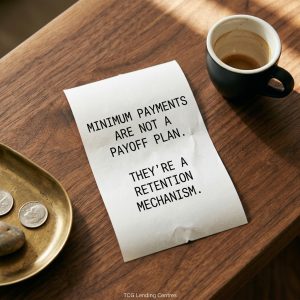
Let me be clear about something most people don’t realize: minimum payments are not a payoff plan. They’re a retention mechanism.
In the 1980s and early 1990s, minimum payments on credit cards were around 5% of the outstanding balance plus interest and fees. The structure forced faster paydown. But as the industry introduced rewards programs and risk-based pricing, they needed to make up lost revenue somewhere. So they dropped minimum payment requirements, sometimes down to 2% or less. This kept balances revolving longer and generated more interest income.
The math is brutal. If you’re carrying $11,400 in credit card debt at the average Canadian interest rate of around 23%, and you only make minimum payments, you’ll pay nearly $18,500 in interest and it will take you 22 years to clear it. At 13% interest on a $14,718 balance, you’re looking at 31 years and over $16,000 in interest.
This isn’t theoretical. This is what happens when the structure works against you instead of for you.
I’ve had clients tell me they’re disciplined, they’re paying more than the minimum, they’re doing everything right. And they are, within the constraints of a system not built to let them win. The problem isn’t effort. It’s the vehicle.
Revolving Debt Creates Lifelong Patterns
There’s research out of West Virginia University tracking credit card users over decades, and what they found is striking. People who carry balances tend to do so for their entire adult lives. These aren’t temporary situations. They’re behavioral patterns getting locked in early and persisting.
The study identified two groups: revolvers and transactors. Transactors pay off their balances every month. Revolvers carry debt and pay interest. And once you’re in one group, you tend to stay there. For decades.
What changed over time? Interest rates. Revolvers used to pay around 15% on average between 2001 and 2019. Now they’re paying closer to 22%. The behavior stayed the same. The cost got worse.
I see this in my practice constantly. Clients who have been carrying balances for five, ten, fifteen years. They’ve refinanced before. They’ve consolidated before. But they went back to the same revolving structure, and the debt came back with it.
That’s the part people miss. You move the debt around, but if you don’t change the structure, the outcome doesn’t change either.
Structured Debt Forces the Discipline Revolving Credit Doesn’t
Here’s the difference: a mortgage has a mandatory payoff date. A credit card doesn’t.
When you consolidate revolving debt into a structured loan, whether a mortgage refinance, a home equity line with a fixed repayment plan, or a personal loan, you’re not lowering the interest rate. You’re changing the entire repayment mechanism.
Even at 14%, a personal loan is cheaper than a 24% credit card. But the real advantage isn’t the rate. It’s the structure. Every payment reduces the principal on a fixed schedule. There’s no option to pay the minimum and let it ride. The loan has an end date. Every payment moves you toward it.
With a mortgage, you’re dealing with rates a fraction of what credit cards charge, often in the 5-7% range depending on the market. And because mortgages are amortized over a set term, you’re not guessing when it will be paid off. You know. The math is clear. The path is defined.
I’ve had clients argue they don’t want to “put debt on their house.” I understand the emotional resistance. But when I walk them through the numbers, what they’re paying in interest on revolving debt versus what they’d pay on a mortgage, and how long each scenario takes to resolve, the math changes the conversation.
You’re not creating new debt. You’re restructuring existing debt into a vehicle paying it down instead of keeping it moving indefinitely.
The Real Cost Is What You’re Not Building
There’s another layer to this not showing up on a statement: opportunity cost.
Every dollar you’re paying in credit card interest at 22% is a dollar not going into savings, investments, or equity in your home. It’s not building anything. It’s servicing a structure designed to extract as much as possible for as long as possible.
When you shift debt into a mortgage or structured loan, you’re not lowering your monthly payment or your interest rate. You’re redirecting cash flow toward something accumulating value over time. Your home equity increases. Your net worth stabilizes. You create margin to start building instead of surviving.
I’ve seen clients free up $800, $1,200, sometimes $2,000 a month by consolidating revolving debt into a mortgage. That’s not breathing room. That’s the difference between staying stuck and being able to move forward.
This Isn’t About Shame—It’s About Mechanics
Nearly half of Americans, 49%, say carrying revolving credit card debt is normal. It’s been normalized because it’s so common. But common doesn’t mean optimal. And it doesn’t mean it’s working.
I don’t think people are failing because they lack discipline or financial literacy. I think they’re failing because the product they’re using was never designed to let them succeed. The structure itself is the problem.
When I sit down with a client who’s been carrying the same $30,000 in credit card debt for six years, I don’t see someone who’s irresponsible. I see someone who’s been trying to dig out with a tool built to keep them in.
The shift happens when you stop treating revolving debt like something you manage within its own rules and start treating it like something needing to be restructured entirely. That’s not a failure. That’s strategy.
What This Means for You
If you’ve been carrying a credit card balance for more than six months, the odds are high you’ll still be carrying it six months from now, unless something changes structurally.
Paying more than the minimum helps. Cutting spending helps. But if the debt is still sitting in a revolving structure, you’re fighting uphill against a system profiting from your persistence.
The alternative isn’t complicated. Consolidate into a structured loan. Lock in a lower rate. Lock in a payoff date. Stop letting the minimum payment dictate your timeline.
You don’t need more discipline. You need better structure.
So here’s the question I’d ask: if you’ve been carrying the same debt for years, and the approach you’re using hasn’t changed the outcome, what would it take to try a different structure entirely?